
June 2026

Email Marketing in the Age of AI: Smarter Campaigns for Better Results

Email Marketing in the Age of AI: Smarter Campaigns for Better Results

Email Marketing in the Age of AI: Smarter Campaigns for Better Results Email marketing is still one of the most lucrative digital marketing mediums in 2026. Nonetheless, the manner in which companies deploy email has undergone tremendous transformation. Artificial intelligence has enabled firms to craft a greater number of personalised, data-driven, and powerful campaigns. Email marketing in the age of AI is a key tool for brands that want to enhance customer engagement, raise conversions, and optimise their investment. The present-day buyer demands pertinent content unloaded at the moment of their interest. Old-style generic email blasts are decreasing in effectiveness. In contrast, AI-enabled email marketing is facilitating companies to send pinpoint-targeted messages that are in line with customers’ behaviour, interests, and preferences. What Is AI Email Marketing? AI email marketing is a method of applying AI technologies in the automation, personalisation, and optimisation of email marketing. Most of the work that marketers do in a manual manner can be done by AI; this includes: Auto-segmentation of the target audience Content personalisation at the email level Subject line optimisation Scheduling emails when they are most likely to be read Behaviour prediction Campaign updates Apart from that, the real advantage of AI-enabled tools is that they assist marketers in constructing email campaigns with a high degree of intelligence, which yield a high degree of results. How Is AI Transforming Email Marketing? Artificial intelligence is impacting different phases of email marketing: Advanced Personalization AI aids in generating tailor-made email messages where it analyses customer habits, order history, and likes as well as levels of participation. Such customised communication is indeed positively correlated with higher percentages of readership as well as higher percentages of sales. Smart Audience Segmentation AI is able to detect customer clusters without human intervention and enable sending messages that are well-targeted to a particular group. Predictive Analytics AI is capable of forecasting the likelihood of specific subscribers in terms of their email opening, link-clicking, or purchasing. Automated Email Workflows AI-based workflows allow businesses to send welcome emails, abandoned cart reminders, follow-ups, and promotional campaigns without manual intervention. Subject Line Optimization Artificial intelligence-based applications can propose subject lines for emails and experiment with variations to find the ones that yield a higher percentage of openings and engagement. Benefits of AI-Powered Email Marketing Taking an email marketing strategy powered by AI has become increasingly a business necessity, as is evident from several studies. Here are some of the major advantages: Higher Open Rates Personalisation and well-matched subject lines enable a sizeable proportion of message recipients to get the gist of the communication and act by opening the email. Better Customer Engagement Perfectly timed and relevant content opens many doors of customer communications due to clicks, comments, and customer-to-customer interactions on social media. Improved Conversion Rates AI makes it possible to synchronise people, messages, and moments in such a way that it increases sales capacities. Time Savings Automation of the execution side of the work also leads to fewer human errors and a higher throughput. Better ROI Identification of the most lucrative customer segments, personalised messages, and excellent timing result in more lucrative marketing investment returns. Best Practices for AI Email Marketing in 2026 Implementing an effective AI email marketing strategy may be a daunting task, but the outcomes are certainly tremendous. The following practices can take your campaigns to the next level: Focus on Personalization Gather and utilise customer data to build relevant and meaningful experiences in order to drive customer loyalty and marketing performance. Maintain Data Quality You can’t expect AI to do better if it is fed with low-quality data. Combine AI with human creativity. AI is capable of producing optimum solutions through data only, but it is not capable of understanding human aspects which have a story, emotion, and a sense of connection. Test and Optimize Consumption of performance data and focus on matters that make significant differences can delight both customers and marketers. Respect Customer Privacy Businesses are bound to comply with the laws aimed at protecting the privacy of customers and the use of their data in an ethical manner. Common Challenges of AI Email Marketing Even though AI is highly beneficial, organisations are still afraid to take the risk of using it. The following is a list of the fears that currently hold back companies. Data privacy concerns Over-automation Poor-quality customer data Lack of human personalization Dependence on technology The trick that the email solutions which have been most successful have used is to incorporate automation without losing the personal touch in communications. The Future of Email Marketing In the future, digital marketing trends 2026, digital marketing will be reshaped by artificial intelligence technology. The following are some of the impacts that companies should keep in mind so that they stay competitive: Highly individualized email communications Customer journey prediction Content customization in real-time Emails automatically written by AI Automation processes that are better than before Marketing with emails will be one of the areas where the customer-centric and cost-saving effects of AI will be most felt. 1. What is AI Email Marketing? Application of artificial intelligence in email marketing for automation, personalisation, and optimisation of the campaigns to get better results. 2. How does AI improve email marketing? By enhancing personalisation, audience segmentation, automating tasks, predictive analytics, and campaign optimisation. 3. Is email marketing still effective in 2026? Yes, absolutely! Email still ranks among the top channels yielding the highest ROIs with the added boost from AI technologies. 4. What are the benefits of AI-powered email campaigns? Greater email open rates, increased number of responses, higher conversion rate, time saved, and enhanced ROI of marketing efforts. 5. Can AI replace email marketers? Not entirely. AI is instrumental for enhancing operational effectiveness as well as continuous improvement, but human imagination, strategic thinking, and comprehensive understanding of customers are crucial for the success of marketing campaigns. Conclusion Email marketing in the age of AI is shifting the way companies communicate with customers. AI enables marketers to build

Why Conversion Rate Optimization (CRO) Is More Important than Traffic

Why Conversion Rate Optimization (CRO) Is More Important than Traffic

Why Conversion Rate Optimisation (CRO) Is More Important than Traffic Many businesses go all out to increase their website traffic, with the assumption that more visitors will automatically lead to more sales. In fact, by 2026, savvy marketers will know that having a lot of traffic is not enough to grow a business. The key factor is what percentage of those visitors actually take some kind of action on your site. That is why Conversion Rate Optimisation (CRO) becomes a necessary tool. Conversion rate optimisation (CRO) essentially means tweaking your website, landing pages and your whole marketing funnel so that a greater percentage of your site visitors end up doing the action you want them to do. Some examples of these actions are buying a product, submitting a form, signing up for a newsletter or asking for a consultation. Rather than always trying to attract new visitors by spending more money, companies can get better outcomes by converting their existing traffic into buyers. What Does CRO Entail? Conversion Rate Optimisation (CRO) is all about enhancing the user experience and removing obstacles that stop visitors from taking the conversion actions. A conversion may be one of the following: Making a purchase Booking an appointment Getting an eBook Submitting a contact form Registering with a newsletter The main objective of CRO is to get the most value out of every person who visits your website. The Problem with Traffic Alone Many websites enjoy a high volume of monthly visits but get very few leads or sales generated. It may be great to talk about large traffic figures, but they don’t necessarily help bring in revenue. For instance: Site A visits are 10,000 with a conversion rate of 1%. Site B visits are 3,000 with a conversion rate of 8%. Despite the fact that Website A has drastically more visitors, Website B actually produces more customers. That simply shows why digital marketing optimisation efforts should be put on improving conversions rather than just visitor numbers. The Effect of CRO on Business Growth Raises Earnings Without Relying on More Traffic Using CRO, businesses can make the most of the revenue from their current audience. This means there is less necessity for the continuous escalation of advertising budgets. Enhances User Experience Websites that are well-designed, easy to navigate and fast to load are more likely to have their visitors convert. Lowers Customer Acquisition Expenses Businesses that enhance their conversion rates get more outcomes from their advertising and marketing efforts, which leads to lower overall acquisition expenses. Produces More Leads That Are Qualified Landing pages and forms that have been appropriately optimised are able to attract and convert higher quality leads. Get the Most Out of Your Marketing Investment Any marketing channel will see increased effectiveness if a greater number of visitors perform the desired actions. Major CRO Tactics in 2026 No CRO plan is complete without a commitment to regularly test and optimise. Make Landing Pages More Effective Landing pages need to communicate a single, clear message along with an attention-grabbing headline and a prominent call-to-action. Faster Website Loading Sites that take longer to load will discourage visitors and lower your chances of converting them. Easier Forms Forms that are shorter are generally associated with higher completion rates and more leads. Show Social Proof People tend to trust others’ opinions more than anything else, so by displaying customer testimonials, reviews and case studies, you should be able to convince readers to act. A/B Testing Trying out various copy, design, layout and offer variations is one way of figuring out what delivers the best engagement. Mobile Alongside Desktop The majority of users will be visiting your site from a mobile phone, so it is critical that your site is responsive and yields high conversion rates. Common CRO Errors to Steer Clear Of Businesses make these errors very frequently, which is detrimental to conversion performance: Complex navigation Very weak calls-to-action Slow page loading speeds Not optimized for mobile No trust signals Ignoring user behavior data Getting rid of these problems can go a very long way towards enhancing your website’s engagement and performance. The Road Ahead for Conversion Rate Optimisation Conversion rate optimisation has become much more dependent on data as the role of technology in marketing is increasing with the introduction of artificial intelligence, predictive analytics and personalisation tools, giving marketers the ability to make very targeted pitches for visitors. Some trends for the future are the following: AI-driven personalised content Predictive analysis of customer behavior Websites dynamically changing content Comprehensive customer journey tracking Automated optimization Those companies that incorporate these advancements will realise greater conversion rates and much stronger relationships with their customers. 1. What is Conversion Rate Optimisation (CRO)? CRO refers to the process of making improvements to a website so that a higher percentage of visitors take actions such as making purchases or signing up. 2. Why is CRO more important than traffic? Simply because traffic will not produce revenue. CRO is a method of turning visits into sales, which makes marketing activities more lucrative. 3. What are common CRO techniques? A few common CRO tactics include A/B testing, modifying landing pages, improving site speed, adding social proof and making calls-to-action more effective. 4. How does CRO improve ROI? CRO means getting more conversions from the same number of visitors so that companies can make a higher profit without having to spend more on marketing. 5. What is a good conversion rate? Although conversion rates are different depending on the industry, by regularly optimising, a business can make a great difference to its performance and results. Summary Conversion Rate Optimisation (CRO) is more significant than traffic because it is directly linked to revenue generation and business growth. Of course attracting visitors is very important, but turning those visitors into your customers is the main driver for success. By improving user experience, testing different strategies and continuing to optimise, your brand can get the most out of its existing traffic and enhance marketing

How Can Digital Marketing Help Small Businesses Grow?

How Can Digital Marketing Help Small Businesses Grow?

How Can Digital Marketing Help Small Businesses Grow? Digital marketing for small businesses is now a necessity for getting persistent growth in today’s market environment, where competition is quite intense. Most of the time, conventional marketing methods are costly and ineffective in reaching the target audience. Digital marketing is a great opportunity for small businesses to not only save on costs but also achieve a lot by drawing in customers, building brand recognition, and competing effectively with their larger counterparts. More and more people are using the internet to find what they want. Because of that, businesses that have made themselves visible digitally are more likely to be found by potential buyers. Digital marketing is a great way to interact with customers through social media, search engine optimisation, email marketing, or content marketing, and you can use any of these methods to grow your business and increase customer satisfaction. Why Is Digital Marketing Important for Small Businesses? Through digital marketing, small business owners will be able to communicate with their customers who mostly spend their time on the Internet, a place where traditional marketing failed to engage them. Moreover, digital marketing allows you to target specific customer segments, assess your campaign effectiveness, and make adjustments to improve results. Some benefits for your business include: Being visible online Receiving better interaction from customers Marketing at a cheaper rate Generating new business leads Converting more customers Building a strong brand recognition These are the reasons why digital marketing has become one of the most important investments for small business growth. How Does SEO Help Small Businesses? SEO for small businesses is a great way to enhance one’s chances of getting a top listing on Google and other search engines. It means when customers go for shopping or seeking services, in plain words, your company’s websites will more likely be at the top of the list. The effect of SEO is the following: Increased un-paid traffic Greater online visibility Enhanced credibility Higher number of qualified leads Long-lasting marketing results SEO is a strong enough method to bring targeted customers consistently without depending much on paid advertisements. How Does Social Media Marketing Support Growth? The use of social media like Facebook, Instagram, LinkedIn, and YouTube has facilitated small businesses in meeting their customers face-to-face digitally. Social media marketing advantages also include the following: Draw up a brand identity Interact with customers Market your products or services Lead the traffic to your website Develop loyal customers Businesses that regularly publish useful content can gain customer trust, thereby resulting in solid relationships. How Can Digital Marketing Generate More Leads? Lead generation is one of the most important tasks that digital marketing accomplishes. Businesses should try and draw in customers through different channels such as search engines, social media, email marketing, and paid advertising. Some tactics for lead generation are: Writing helpful content Sharing freebies and other pieces of content Creating targeted advertising campaigns Using landing pages Doing email marketing These will help you get contact information of visitors and convert prospects into customers. Why Is Content Marketing Important? Having content marketing is a form of doing business to educate, inform, and engage with your audience. So it might be a blog, video, guide, or social media post that will help you answer customers’ questions and build a reputation as an authority figure. Content marketing pros: Ranking better in search engines Getting more traffic to websites Building customers’ trust Receiving higher engagement Enhancing one’s brand image High-quality content is one of the significant factors that show a business knows the industry in-depth. The Future of Digital Marketing for Small Businesses Technological innovation is taking place at a very fast pace, so we are witnessing how digital marketing is continuing to present different ways for businesses to expand. Artificial intelligence, voice search, automation, and highly personalised customer journeys are some examples of how marketing is being transformed. Small businesses that integrate digital marketing into their plans can: Access more people at a time Make customers have a better experience Be more functional and efficient Start seeing results of efforts more quickly Hold their own against bigger brands Keeping up with the trends in the industry is very much needed if one wants to succeed for a long time. 1. How does digital marketing help small businesses grow? With digital marketing aimed at increasing their visibility, attracting new customers, lead generation, and better customer engagement. 2. Why is SEO important for small businesses? Businesses use SEO to rank higher in search results, which in turn leads to more organic traffic and attracting qualified customers. 3. Which digital marketing channel is best for small businesses? The best channel depends on the business concern; however, deciding among SEO, social media marketing, and content marketing will yield highly effective results. 4. How can social media help small businesses? Social media platforms enable small businesses to establish their brands, engage with customers, market their offerings, and ultimately drive traffic to their websites. 5. Is digital marketing affordable for small businesses? Definitely! Digital marketing is cost-effective and provides small businesses with a level playing field to access targeted audiences while also efficiently measuring their results. Conclusion Digital marketing for small businesses is definitely a very good idea since it allows you to be more visible, get customers, and increase your business in a way that is sustainable for the long term. Leveraging SEO, social media marketing, content creation, lead generation, and online advertising, small businesses can forge strong customer relationships and extend their reach to the market. Digital marketing adoption is expected to be a priority for those in the business in 2026 and beyond. Those who decide to embrace it will be the ones who grow, are able to compete, and succeed in the long run. Through investing in the right strategies and giving value on a consistent basis, small businesses will be able to change their online presence into a strong growth machine.

Personal Branding for Business Owners: A Digital Marketing Advantage

Personal Branding for Business Owners: A Digital Marketing Advantage

Personal Branding for Business Owners: A Digital Marketing Advantage Deeply engaged in the highly competitive realm of digital marketing, personal branding for business owners has emerged as the most powerful tool to differentiate themselves while gaining customer trust. People tend to connect more with people rather than logos and companies. Therefore, business owners who are on the personal branding bandwagon will be able to enjoy stronger relationships, increased credibility, and significantly higher business growth possibilities. Today, it is the huge demand of the world that people be real, open, and experts in their profession. Having a well-established personal brand is indeed a stepping stone for business owners to display their wisdom, principles, and distinctiveness and, at the same time, make connections with their target audiences. This is what makes personal branding a very strong digital marketing edge for businesses both big and small. What Is Personal Branding? Personal branding refers to the development and consistent promotion of a professional personality along with expertise, experience, values, and character. It is essentially the overall reputation that one creates both online and in reality. Nevertheless, for business owners, creating a personal brand even become a way of marketing themselves. This is about turning oneself into a figure of trust and a source of great knowledge in one’s field. By producing content, getting involved with social media, speaking publicly, and leading through thoughts, business owners get to be known by the ones that customers, business partners, and headhunters consider. With a well-established personal brand, people will easily remember you as well as your principles. Why Is Personal Branding Important for Business Owners? Nowadays, customers would mostly rely on their level of trust to make purchasing decisions. Actually, quite a number of them would go through thorough investigation of the people behind a certain business before closing a deal. Namely, a business owner endowed with a strong personal brand should be able to: Earn reliability and confidence Raise brand awareness Conquer the position of industry leader Source qualified leads Make customers more loyal Highlight differences from competitors Allow for continuity of growth Trust a business owner, and customers are more likely to trust the whole business. How Does Personal Branding Support Digital Marketing? Personal branding, together with digital marketing, is a powerful duo featuring a major impact on the overall online presence. Improves Content Marketing People would just naturally be more interested in the contents that come from a well-known and trustworthy individual. Reality chronicles, cases, and profound work undoubtedly make materials deeply authentic and appealing. Enhances Social Media Marketing As proof of knowledge through diverse social media platforms together with business owners, one can showcase a huge population of loyal supporters and escalate high levels of engagement. Supports Search Engine Visibility Consistently sharing useful posts under a personal brand is what is going to bring not only increased web publicity but also ongoing authority on topics close to search engines. Increases Customer Trust Seeing the other side of the business aspects, namely the people behind the brand, is what actually connects customers emotionally first. How Can Business Owners Build a Strong Personal Brand? Developing a personal brand is quite a repetitive task needing a well-defined and solid plan. Define Your Expertise Figure out which subjects, talents, and happenings within your sphere will execute your brand build. Create Valuable Content Distribute helpful writings and visual clips, and state one’s thoughts and updates by constantly working on this. Be Active on Social Media Keep a daily schedule for talking to your followers, throwing out an idea, or sending out your knowledge. Showcase Authenticity Be real and trackable through showing your true feelings and experiences in the right way. Usually, such a thing leads to meaningful association and trust growth. Maintain Consistency Wherever you are leading, your words, principles, and ways of communication shall be the same. Common Personal Branding Mistakes to Avoid A lot of business owners find personal branding pretty much challenging just because they keep the wrong focus between promotion and value. You should steer clear from these common mistakes: Messages coming out of you are the opposite of each other All the time thinking about selling Doing nothing to encourage your audience Not being faithful to your own self Making content rarely Highly successful personal branding is based on your willingness to help, educate, and establish a relationship with people instead of selling all the time. The Future of Personal Branding in 2026 With internet becoming saturated and competition getting fiercer, personal branding may only get bigger. Artificial intelligence could very well take over a lot of marketing tasks, but interaction with a human being is something which cannot be replaced ever. Most customers at present want to deal with the enterprises that are run by the individuals who are not only visible but also knowledgeable and trustworthy. Hence, thought leadership, video-making, and podcasts, as well as community-building activities, will keep strengthening a person’s brand in the years to come. Business owners who will begin investing in personal branding are the ones who will have the most leveraging power over their competitors down the road. 1. What is personal branding for business owners? It is the whole process of developing and curating a professional image that conveys your expertise, values, and industry knowledge. 2. Why is personal branding important in 2026? It is a key enabler of business owners to build trust, increase visibility, assert their authority, and attract more customers. 3. How does personal branding support digital marketing? Quite simply, through strengthening content marketing, social media engagement, customer trust, and overall online visibility. 4. Which platforms are best for personal branding? Highly effective ones include LinkedIn, YouTube, Instagram, Facebook, X, podcasts, and personal websites. 5. How long does it take to build a strong personal brand? Most people view personal branding as a continuous effort that requires making content, audience engagement, and credibility building consistently over time. Conclusion Personal branding for business owners is a must in 2026 and beyond, a

AI-Digital Marketing: Artificial Intelligence is Changing Business Growth

AI-Digital Marketing: Artificial Intelligence is Changing Business Growth

AI-Digital Marketing: Artificial Intelligence is Changing Business Growth The digital marketing sector is experiencing a significant change, with AI digital marketing at the forefront. AI is being employed by businesses to analyse data, figure out customer behaviour, automate processes, and provide personalised experiences on a huge scale. As the level of competition rises over industry, companies are resorting to AI for improving their efficiency, raising the level of their customer interaction, and eventually leading to the growth of the business. Businesses that utilise artificial intelligence for marketing will be able to take a great step forward compared to their rivals in 2026. AI is transforming the way brands engage with their customers and attain marketing objectives, including content, email marketing, customer support, and predictive analytics. AI-Powered Digital Marketing: What Is It? ‘AI-powered digital marketing’ means using AI tools to enhance marketing tactics, automate marketing operations, and make decisions based on data. AI can digest tremendous amounts of data, detect regularities, and come up with insights that enable marketing professionals to refine their promotions and increase their efficacy. With AI assistance, organisations can shift from depending mostly on human activities to a much smoother way of doing marketing. Therefore, marketers will have more time for the aspects that matter the most, such as devising marketing strategies, unleashing creativity, and cultivating customer relations. Ways in Which AI Is Changing Digital Marketing Artificial intelligence is even affecting areas of modern marketing, nearly doubling. Sharp Customer Insights AI has a knack for merging customer data across different points and finding patterns, preferences, and behaviour. This info lets companies launch pinpoint marketing campaigns and lift the total customer experience. Personalized Marketing People want their interactions to be tailored to their liking. AI gives a company the power to serve content, recommend products, and make deals closely tied to individual user behaviour and preferences. Content Creation Hulk A lot of AI marketing instruments work together in coming up with topics, preparing texts, posting on social media, and adjusting marketing material. It is a win-win situation where output is boosted without losing a writer’s personal touch. More Winning Ads By pinpointing accurate targets, tweaking bids, and refreshing ad targets on the fly, AI will lead to the best marketing campaigns. Richer Customer Support Instant customer responses are a definite promise for AI-driven chatbot and virtual assistant systems, resulting in greater customer satisfaction and fewer response times. Advantages of AI-Driven Digital Marketing The implementation of AI marketing solutions puts companies on a path to reap many advantages. Liberated Workout By minimising manual work, automation lets the workforce concentrate on things that bring value. Rethinking AI enables marketing teams to draw on a broad variety of data points, analyse ongoing trends, and make forecasts. Higher Customer Engagement Customised content captures the attention of users and encourages active involvement. More Lead Generation Using AI-based marketing tools, lead scoring and lead conversion are made more efficient. Elevated ROI More focused marketing strategies, together with better-advertised tips, will ensure that firms obtain results with their spending in marketing. AI Marketing Tools You Need to Know in 2026 Below are listed some of the most-used tools that are based on AI. Typical usage scenarios entail the following: Platforms for content generation Systems for email marketing automation   AI-powered chatbots Customer relationship management (CRM) software Predictive analytics tools Social media control tools The implementation of these techs has resulted in a dual benefit wherein companies operate faster and customers’ experiences remain top-notch. Problems with AI Marketing While AI comes with larger-than-life benefits, there are certain pitfalls that companies would do well to keep in mind. The list of issues that are often brought up includes the following: Data privacy and security Overreliance on automation Preserving the authenticity of content Trusting AI-generated data Mixing technology and human talent A keen insight-oriented use of AI that accompanies human skill and strategic thinking in marketing has even more potential for success. 2026 Vision: AI-Powered Digital Marketing The coming years will see emerging industries of digital marketing extremely influenced by artificial intelligence. As more AI features become available, businesses will be able to harness highly specialised personalisation, predictive analytics, and automation tools. Along with voice search optimisation, AI-generated content, smart customer interactions, and on-the-fly marketing campaign improvements. Commercial entities that react in time to these developments will establish themselves as long-term growth leaders and market masters. 1. Can you explain AI-powered digital marketing? AI-powered digital marketing means applying AI technologies in automating promotion tasks, analysing data, and enhancing campaign outcomes. 2. In what ways does AI contribute to business growth? AI leads to efficiency gains, personalisation of user experience, better targeting, and decision-making support, which eventually results in the growth of the business. 3. Which are the most common AI marketing tools? The ringleaders among the AI marketing tools are AI chatbots, content generation programs, marketing automation applications, CRM systems, and predictive analytics tools. 4. Is there a possibility of AI replacing digital marketers? Absolutely not. AI supports marketers by automating tasks and providing insights, but human creativity, strategy, and relationship-building remain essential. 5. Why is AI crucial for digital marketing in 2026? AI equips businesses with the power to remain competitive through better personalisation, increased efficiency, campaign optimisation, and improved customer experience. In Summary Companies are using AI-powered digital marketing to change how they reach, engage, and convert customers. With the help of AI, a business can become more efficient, provide personalised experiences, run campaign optimisation, and also make smarter marketing decisions. Risk factors exist, but the scope for benefits outweighs them when the AI-driven marketing is implemented wisely. With the above digital competition becoming more intense, businesses adopting AI in marketing would obtain a major advantage. AI is not a concept for the future; it is one that businesses require today to be able to operate sustainably and expand both in 2026 and beyond.

A Digital Marketing Advantage

A Digital Marketing Advantage

 Personal Branding for Business Owners: A Digital Marketing Advantage   Deeply engaged in the highly competitive realm of digital marketing, personal branding for business owners has emerged as the most powerful tool to differentiate themselves while gaining customer trust. People tend to connect more with people rather than logos and companies. Therefore, business owners who are on the personal branding bandwagon will be able to enjoy stronger relationships, increased credibility, and significantly higher business growth possibilities. Today, it is the huge demand of the world that people be real, open, and experts in their profession. Having a well-established personal brand is indeed a stepping stone for business owners to display their wisdom, principles, and distinctiveness and, at the same time, make connections with their target audiences. This is what makes personal branding a very strong digital marketing edge for businesses both big and small. What Is Personal Branding? Personal branding refers to the development and consistent promotion of a professional personality along with expertise, experience, values, and character. It is essentially the overall reputation that one creates both online and in reality. Nevertheless, for business owners, creating a personal brand even becomes a way of marketing themselves. This is about turning oneself into a figure of trust and a source of great knowledge in one’s field. Via producing content, getting involved with social media, speaking publicly, and leading through thought, business owners get to be known by the ones that customers, business partners, and headhunters consider. With a well-established personal brand, people will easily remember you as well as your principles. Why Is Personal Branding Important for Business Owners? Nowadays, customers would mostly rely on their level of trust to make purchasing decisions. Actually, quite a number of them would go through thorough investigation of the people behind a certain business before closing a deal. Namely, a business owner endowed with a strong personal brand should be able to: Earn reliability and confidence Raise brand awareness Conquer the position of industry leader Source qualified leads Make customers more loyal Highlight differences from competitors Allow for continuity of growth Trust a business owner, and customers are more likely to trust the whole business. How Does Personal Branding Support Digital Marketing? Personal branding, together with digital marketing, is a powerful duo featuring a major impact on the overall online presence. Improves Content Marketing People would just naturally be more interested in the contents that come from a well-known and trustworthy individual. Reality chronicles, cases, and profound work undoubtedly make materials deeply authentic and appealing. Enhances Social Media Marketing As proof of knowledge through diverse social media platforms together with business owners, one can showcase a huge population of loyal supporters and escalate high levels of engagement. Supports Search Engine Visibility Consistently sharing useful posts under a personal brand is what is going to bring not only increased web publicity but also ongoing authority on topics close to search engines. Increases Customer Trust Seeing the other side of the business aspects, namely the people behind the brand, is what actually connects customers emotionally first. How Can Business Owners Build a Strong Personal Brand? Developing a personal brand is quite a repetitive task needing a well-defined and solid plan. Define Your Expertise Figure out which subjects, talents, and happenings within your sphere will execute your brand build. Create Valuable Content Distribute helpful writings and visual clips and state one’s thoughts and updates by constantly working on this. Be Active on Social Media Keep a daily schedule for talking to your followers, throwing out an idea, or sending out your knowledge. Showcase Authenticity Be real and trackable through showing your true feelings and experiences in the right way. Usually, such a thing leads to meaningful association and trust growth. Maintain Consistency Wherever you are leading, your words, principles, and ways of communication shall be the same things. Common Personal Branding Mistakes to Avoid A lot of business owners find personal branding pretty much challenging just because they keep the wrong focus between promotion and value. You should steer clear from these common mistakes: Messages coming out of you are the opposite of each other All the time thinking about selling Doing nothing to encourage your audience Not being faithful to your own self Making content rarely Highly successful personal branding is based on your willingness to help, educate, and establish a relationship with people instead of selling all the time. The Future of Personal Branding in 2026 With internet becoming saturated and competition getting fiercer, personal branding may only get bigger. Artificial intelligence could very well take over a lot of marketing tasks, but interaction with a human being is something which cannot be replaced ever. Most customers at present want to deal with the enterprises that are run by the individuals who are not only visible but also knowledgeable and trustworthy. Hence, thought leadership, video-making, and podcasts, as well as community-building activities, will keep strengthening a person’s brand in the years to come. Business owners who will begin investing in personal branding are the ones who will have the most leverage over their competitors down the road. 1. What is personal branding for business owners? It is the whole process of developing and curating a professional image that conveys your expertise, values, and industry knowledge. 2. Why is personal branding important in 2026? It is a key enabler of business owners to build trust, increase visibility, assert their authority, and attract more customers. 3. How does personal branding support digital marketing? Quite simply, through strengthening content marketing, social media engagement, customer trust, and overall online visibility. 4. Which platforms are best for personal branding? Highly effective ones include LinkedIn, YouTube, Instagram, Facebook, X, podcasts, and personal websites. 5. How long does it take to build a strong personal brand? Most people view personal branding as a continuous effort that requires making content, audience engagement, and credibility building consistently over time. Conclusion Personal branding for business owners is a must in 2026 and beyond,

How AI Search from Google Is Altering Digital Marketing

How AI Search from Google Is Altering Digital Marketing

How AI Search from Google Is Altering Digital Marketing The robustness of Google’s AI Search has come to be the primary driver of change in the digital marketing domain. With the rollout of AI-driven scenarios which include search overviews by Google and generative search outputs, the business sector has become inclined towards fresh content methodologies, SEO, marketing on social media and more. SEO in the past used to focus on ranking web pages by the use of keywords and backlinks only. Presently, Google’s AI Search goes as far as to comprehend user intent, analyse a plethora of sources, and issue direct answers right within the search results. Such an upheaval is leading to a total change of the way users seek information and how businesses strive to gain visibility online. For enterprises and marketing professionals, grasping the concept of AI search optimisation is the key to maintaining competitiveness in 2026 and subsequent years. What Does Google’s AI Search Feature? Through Google’s AI Search feature, highly sophisticated artificial intelligence and machine learning techniques are employed to render search experiences that are not only more relevant but also personalised and conversational. The AI-powered search engine doesn’t just list websites but is capable of summarising content, directly answering questions, and recommending contexts. The objective of this is to expedite the information-seeking process for users and also to lower their dependence on several websites. It implies that companies who want to be seen in AI-powered search result pages must upgrade their digital marketing approaches. In What Ways Are Google’s AI Search Upending SEO? An enormous consequence of Google’s AI Search is the impact on classic SEO methods. In the past, securing a spot on the first page of the search engine results was deemed good enough to bring in visitors. However, with the advent of AI-generated answers that occupy positions above the organic listings, user behaviour will definitely change. Some major SEO transformations are: Emphasis Shifted More to User Intent Google’s AI Search mainly focuses on matching exactly what the users want to know rather than just the use of keywords matching. Stringent Content Quality Requirements Engagement time and quality will be the deciding factors for ranking higher in the search results, so the content should be comprehensive and from a credible source. Decreased Emphasis on Keyword Frequency Present-day SEO is concentrated more on getting the gist of topics, semantic comprehension, and user experience rather than on repeatedly using keywords. Structured Content Has Become More Indispensable Well-defined headings, brief responses, and content laid out in a logical manner tee up one’s chances of being pulled up for AI-generated answers versus competitor sites. How Come Answer Engine Optimisation (AEO) Has Become a Must? Given the widespread use of AI-generated search results, Answer Engine Optimisation (AEO) is escalating its importance concurrently. The core of AEO is to develop content that enthusiastically and clearly answers the questions users ask. Companies can take their visibility up several notches if they: Develop FAQ sections Employ question-based subheadings Offer brief but comprehensive answers Use schema markup Produce conversational textual content AEO equips firms to show up in AI-generated recaps, spotlight snippets, and voice search outcomes. What Effect Does AI Search Have on Content Marketing? The aim of content marketing is still very much the same, but the methods of producing and optimising it are changing along the way. To get content marketing right, businesses should concentrate on: Generating Useful Content Content should be practical and address user issues and specific questions. Showcasing Knowledge and Competence A Google trend is to give more credit to content written by well-informed entities. Providing an All-round Topic Coverage Extensive content that delivers deep insights into various angles of a topic performs better in AI-powered search. Keeping Content Up-to-Date Recent and accurate materials enhance credibility as well as search visibility. Companies focusing largely on catering to users’ needs through good content will turn out to be winners when Google’s most up-to-date algorithm kicks in. What Poses New Opportunities with Google’s AI Search? While some businesses fret over dwindling traffic to their sites, Google’s AI Search at the same time unlocks fresh channels and openings. Among the advantages are the following: More visibility in AI-powered responses Better addressing of user intent Going up the ladder in your brand’s authority Gaining more customer trust Getting more qualified traffic Those businesses that are the fastest in adjusting can, in no time, become the go-to thinkers among their peers in the industry. How Should Companies Gear Up for What’s Next? With the coming of age of AI-powered search, companies must: Create evergreen content instead of just chasing trends Be equally good at AEO and SEO Keep the user experience foremost Adopt structured data markup Build topical authority Stay abreast of emerging search trends Those who will warmly accept these kinds of changes in our increasingly digital environment are the ones who will find themselves visible and able to draw customers in the constantly changing search landscape. 1. What is Google's AI Search? Google’s AI Search employs artificial intelligence to give conversation-like answers, highlights and more personalised search experiences. 2. What effect does AI search have on SEO? AI Search emphasises matching users’ true intents, quality of content and getting direct responses greatly, making traditional keyword-centric SEO less impactful alone. 3. What does AI search optimisation mean? AI search optimisation refers to the effort of creating content that holds the potential of being well-ranked in AI-powered search results and answer engines. 4. What role does AEO play in Google's AI Search? The practice of AEO assists companies to be featured in AI-generated responses, featured snippets, and voice searches. 5. What can companies do to get ready for AI-powered search? Instead of just focusing on the quality of content, companies should also focus on structured data, user intent, SEO, and AEO as well as strategies for long-term visibility and growth. Summary Google’s AI Search is the reason for the ongoing metamorphosis of digital marketing by not only altering the way

Uncategorized

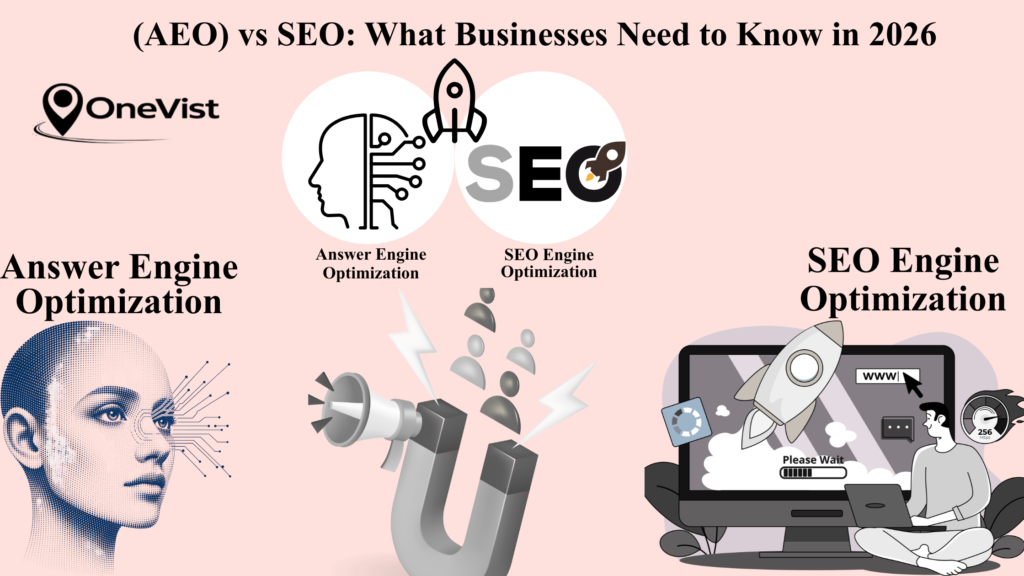
(AEO) vs SEO: What Businesses Need to Know in 2026

 Answer Engine Optimisation (AEO) vs SEO: What Businesses Need to Know in 2026? The way of navigating digital search is continually evolving. Traditionally, improving one’s ranking in search results and increasing website traffic depended mainly on SEO strategies. However, the advancements in AI-assisted searches, voice-enabled devices, and searches orientated around finding exact answers have given rise to a new concept that is ‘answer engine optimisation’, or ‘AEO’. In the year 2026, companies have to be knowledgeable about the distinction between AEO vs SEO as well as the interaction of these strategies. On the one hand, SEO is the means for webpages to be ranked in lists of search results on engines. On the other hand, AEO is only revolving around the provision of immediate answers that the users can obtain from AI systems and voice assistants. What Is SEO? Search Engine Optimization (SEO) denotes the practice of enhancing the rank position of a website on popular search engines like Google, Bing, etc. The ultimate target is to feature at the top positions for pertinent keywords, thereby generating organic traffic. The main elements of SEO are: keyword targeting writing excellent pieces of content getting quality links making site better by doing technical SEO making website mobile-friendly enhancing the overall user experience Since SEO can help businesses become more visible online and gain potential customer traffic, a digital marketing strategy without SEO is unthinkable. What Is Answer Engine Optimisation (AEO)? Answer Engine Optimisation (AEO) represents an approach focused on optimising content that satisfies user intent by direct answer provisions, response accuracy, and information completeness. Through it, a business is not simply striving for a search engine ranking but aiming at getting featured in AI-generated answers as well as in snippets, voice assistant results, and answer engines. AEO employs: content that answers questions using FAQ sections marking content with structured data conversational tone optimization for featured snippets optimization for voice search With the gradual surge in adoption of AI tools as well as the integration of AI features in the leading search engines, prioritisation of AI Search Optimisation (APO) is an imperative step that a business must take for its survival in the online world display. AEO vs SEO: Key Differences We know that AEO and SEO are closely connected, but they serve totally different aims. SEO Focuses On: bringing traffic to the website achieving high ranking through targeted keywords visibility improvement on a search engine level natural clicks increase AEO Focuses On: answering directly presence among AI-generated responses voice assistants results featured snippets and knowledge panels In brief, SEO is about enabling a user to locate a website, whereas AEO is about getting the user direct answers from one’s content. Why Is AEO Becoming Important in 2026? We are witnessing a major change in user behaviour when it comes to interacting with search engines. Users are increasingly formulating complete and complex questions when using AI assistants, voice search tools or their smart devices. Examples of such questions are: What is the best digital marketing strategy in 2026? How does AEO differ from SEO? Which SEO techniques work for AI search? Users don’t hesitate to get quick answers rather than visiting old-fashioned websites. Thus, the answer engine optimisation is flourishing. Companies that are able to adapt to implementations of AEO are revealed even when the user is not clicking on traditional search results. How Can Businesses Optimise for Both SEO and AEO? The best plan for SEO in 2026 is to combine both methods. Create Question-Based Content Address the standard customer questions by using engaging headings as well as clear and short descriptions. Add FAQ Sections FAQs both assist the search engines and the AI tools in properly interpreting the content. Use Structured Data Schema markup assists in boosting the prominence of content within rich results as well as AI-generated responses. Focus on User Intent Content that is tailored to address exactly what users want to learn will be most successful. Optimize for Voice Search Try to match the natural language patterns and the conversational styles that people tend to use when speaking. Improve Content Quality The two, SEO and AEO, are deeply committed to rewarding valuable, accurate, and trustworthy content. The Future of Search: SEO and AEO Together Choosing one between AEO and SEO is not the future of digital marketing. What companies actually should do is an integration of both these strategies in their content marketing plan. SEO will remain the principal driver of obtaining organic traffic, whereas AEO will make it possible for the brands to get visibly located in AI-powered search experiences. The groups that have been doing traditional search engine optimisation as well as modern answer engine optimisation are going to acquire greater strength to compete. 1. What is the difference between AEO and SEO? SEO emphasises the improvement of the ranking position of a website and organic visitor generation, whereas AEO values the provision of the exact answers for AI engines and voice assistants 2. Why is AEO important in 2026? AEO is crucial as more and more people are utilising AI-powered tools and voice-activated assistants to receive their answers instantly. 3. Can AEO replace SEO? Definitely not. AEO simply supports SEO. Practically, companies should implement both strategies simultaneously. 4. How do I optimise content for AEO? One can optimise for AEO by considering questions as a focus with headings, FAQs, data structure, conversational tone, and short answers. 5. Which is better: AEO or SEO? On the contrary, none of them is individually better. The most effective approach is that of mixing AEO and SEO so as to have maximum visibility in top search results and also on AI-based platforms. Conclusion It has always been the AEO vs SEO controversy that stirred discussion. It is not about discarding one of the strategies, but 2026 is the year when undoubtedly both are vital for online presence. SEO is the vehicle that drives businesses to website visitors and good ranking; AEO is the means through which content gets

Scroll to Top